Author name: digitalpinalgada@gmail.com

PINAL GADA - A certified digital marketer. A digital marketer is a creative and results-driven professional who helps businesses grow their online presence and reach the right audience. She uses strategies such as SEO, social media marketing, content creation, email marketing, paid advertising, and analytics to increase brand awareness and generate leads. She stays updated with the latest digital trends, technologies, and consumer behavior to create effective campaigns. Combining creativity with data-driven insights, she develops engaging content and marketing strategies that deliver measurable results. Her goal is to build strong digital brands, connect with customers, increase engagement, and drive sustainable business growth in a competitive online marketplace.

BLOG

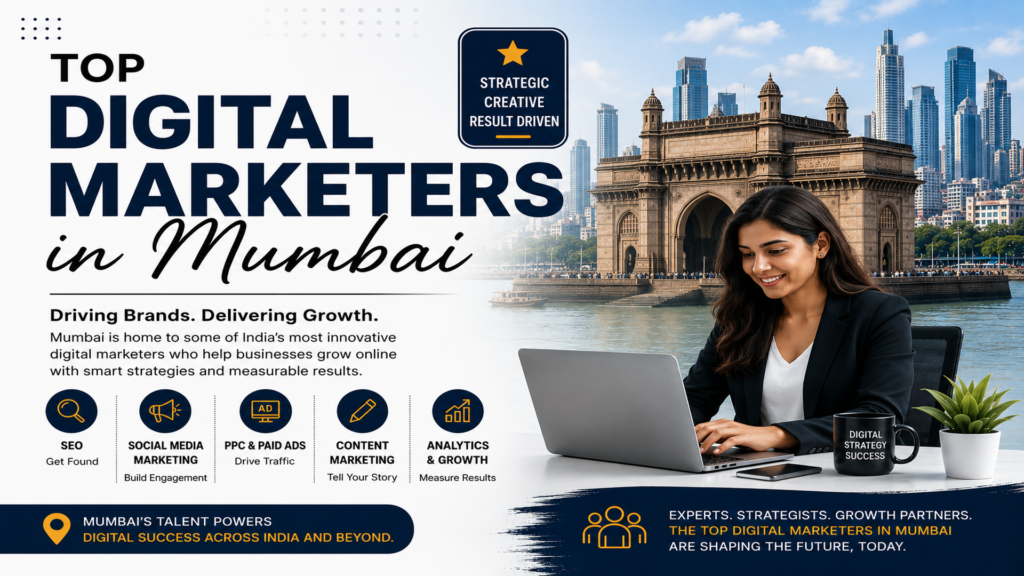
Best Freelance Digital Marketer in Mumbai – 2026

In today’s competitive business landscape, finding a reliable freelance digital marketer in Mumbai who can scale high-converting ad campaigns and deliver real ROI is crucial for business growth. Mumbai is one of the fastest-growing business centers in India, and brands fight hard for customers online. Businesses that want to do well online need digital marketing experts who are certified and have experience. These experts should be able to show results through SEO, social media marketing, Google Ads, and performance marketing strategies. Want to start your freelancing journey? Read this guide on How to Become a Freelance Digital Marketer in 4 Months. Here are some of the best digital marketers in Mumbai who are known for offering digital marketing services that get results. DIGITAL PINAL GADA-Freelance Digital Marketer In Mumbai When looking to collaborate with a results-driven freelance digital marketer in Mumbai, tracking hands-on execution and past case studies is essential. Digital PINAL is a certified digital marketer in Mumbai who focuses on SEO, social media marketing, Google Ads management, website development, graphic design, and ways to get more leads. She focuses on digital marketing solutions that are based on data and help businesses get better search engine rankings, more high-quality leads, and more visibility online. Her focus on performance makes sure that both new and old brands can grow in a way that lasts and get a better return on investment. Why Choose Her: She specializes in engineering tailor-made, 360-degree growth frameworks specifically mapped out for small-to-medium enterprises across Mumbai looking to scale rapidly. Contact Details: Andheri east, MumbaiEmail: digitalpinalgada@gmail.comPhone: 8779922071Website:https://digitalpinal.co.in DIGITAL NISHAN – Freelance Digital Marketer In Mumbai Choosing an independent specialist who understands local market dynamics gives you the exact competitive edge you expect from a top freelance digital marketer in Mumbai. Digital NISHAN is a certified digital marketing expert in Mumbai who offers a full range of digital marketing services, such as search engine optimization (SEO), social media management, Google Ads campaigns, and online branding. He helps companies improve their online presence by planning strategic campaigns and using performance-based marketing solutions. Why Choose Him: Nishan excels at identifying exact audience pain points and translating them into brilliant, engaging social media campaigns that build long-term brand equity for local Mumbai startups. Contact Details:Andheri west, MumbaiEmail: nishandigital68@gmail.comPhone: 9401679794Website: https://digitalnishan.co.in/ DIGITAL SABIR SHAH – Freelance Digital Marketer In Mumbai A widely respected name in the Mumbai freelance scene, Digital sabir shah offers extensive 360-degree digital blueprints out of his base in goregaon west. Specialties: Comprehensive Search Engine Marketing (SEM), automated Facebook ad workflows, and local map pack ranking optimization. Why Choose Him: sabir has handled over a hundred multi-niche projects, making him incredibly skilled at launching cost-effective lead generation funnels for local service businesses. Contact Details:goregaon west, MumbaiEmail: digitalsabirshah@gmail.comPhone: 9920476082Website: https://digitalsabir.co.in/  DIGITAL SAMEER SHAH – Freelance Digital Marketer In Mumbai A dynamic and results-driven specialist, digital sameer enters our list as a top contender for the best certified digital marketer in Mumbai. He is an elite technical marketer focused heavily on helping local businesses maximize their digital real estate. Specialties: Advanced on-page optimization, UI/UX-focused WordPress design, lead generation campaigns, and web analytics tracking. Why Choose Him: sameer excels at turning raw website traffic into high-value customer inquiries by optimizing the user journey from the very first click. Contact Details:goregaon west, MumbaiEmail: digitalsameershah@gmail.comPhone: 6394841032Website: https://digitalsameers.co.in/ Why You Must Partner With the Best Certified Digital Marketer in Mumbai Selecting the right partner can completely alter your brand’s trajectory. When you collaborate with a dedicated freelance professional, you gain three major advantages: 1. Hyper-Local Market Knowledge: Mumbai’s demographic shifts fast. A local marketing professional understands regional consumer behavior, neighborhood density, and purchasing power nuance far better than an offshore team. 2. Data-Informed Flexibility: Unlike giant agencies that recycle cookie-cutter templates, independent certified experts can shift ad budgets, alter keyword targeting, and update web assets instantly based on real-time campaign performance. 3. Drastic Cost Optimization: You get direct access to elite skills without footing the bill for corporate agency overhead, office rent, or account managers. Every single rupee goes straight into driving conversions. Conclusion: Take the Lead in the Digital Landscape The search results on Google make one thing incredibly clear: businesses with a weak or outdated digital footprint are losing ground to competitors every single day. Whether you need to fix a broken sales funnel, build a responsive website, or deploy highly profitable paid ads, partnering with the best certified digital marketer in Mumbai is your shortcut to sustainable market growth. Explore Grow Digital Institute to learn digital marketing through AI-powered training, real client projects, internships, and career-focused programs. Don’t let your brand stay invisible online. Review the portfolios of these top 10 experts, find the professional that aligns with your operational goals, and take your business to the next level.
BLOG

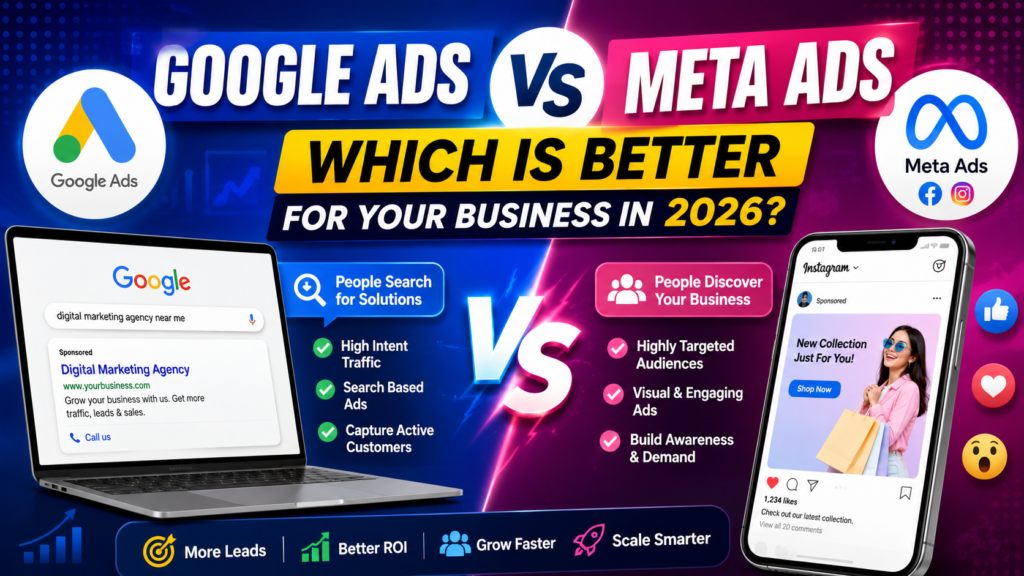
GoogleAds vs MetaAds: Which Is Better for Your Business in 2026?

In 2026, paid advertising is one of the most effective ways for businesses to reach potential customers online. Two of the biggest advertising platforms are Google Ads and Meta Ads, which includes advertising across Facebook and Instagram. Both platforms can generate leads, sales, website traffic, and brand awareness, but they work in very different ways. Google Ads primarily helps businesses reach people who are actively searching for a product or service, while Meta Ads can help businesses reach people based on their interests, behaviors, demographics, and online activity. So, which platform is better for your business in 2026? The answer depends on your business goals, target audience, budget, product, and marketing strategy. 1. How Google Ads Works Google Ads is largely based on search intent. When someone searches for something such as “best digital marketing agency in Mumbai” or “buy running shoes online,” businesses can show advertisements related to that search. This makes Google Ads particularly useful when customers already know what they want. For example, imagine someone searches for “AC repair near me.” A local AC repair company can use Google Ads to appear when that person is actively looking for an AC repair service. Google also offers other advertising formats, including display, video, shopping, and app campaigns. This allows businesses to reach potential customers at different stages of the buying journey. 2. How Meta Ads Works Meta Ads operates differently. Instead of primarily waiting for people to search for a product, businesses can place ads in front of users based on audience and campaign signals. Ads can appear across platforms such as Facebook and Instagram. Meta is especially powerful for visually attractive products and services. Businesses can use images, videos, Reels, Stories, carousels, and other creative formats to capture attention. For example, a fashion brand can show a new collection to people who are likely to be interested in fashion. A restaurant can promote a special offer to people in a particular geographic area. Meta’s Advantage+ features also use automation and machine learning to help advertisers optimize campaign delivery. 3. Google Ads vs Meta Ads: Search Intent One of the biggest differences is customer intent. Google Ads is often stronger when customers are already looking for a solution. For example: “Buy iPhone 17 online”“Best dentist in Ahmedabad”“Digital marketing course near me” These searches indicate that the person may already be interested in taking action. Meta Ads can be better for creating demand. Someone may not be actively searching for a product but could become interested after seeing an engaging advertisement. Therefore, Google often works well for high-intent demand capture, while Meta can be excellent for demand generation and discovery. 4. Which Platform Is Better for Lead Generation? Both platforms can generate leads, but the better choice depends on the type of business. For businesses where customers actively search for services, Google Ads can be highly effective. Examples include: Meta Ads can work particularly well when the offer can be presented visually or when businesses want to reach a specific audience. Examples include: The quality of the landing page and follow-up process also matters greatly. Getting clicks is not enough—you need to convert those visitors into customers. 5. Google Ads vs Meta Ads for E-Commerce For e-commerce businesses, both platforms can be powerful. Google Ads can capture people who are already searching for specific products. Product-focused campaigns can help businesses appear when shoppers are comparing products or looking to buy. Meta Ads can help introduce products to potential customers through visually engaging content. Businesses can use product images, videos, testimonials, creator-style content, and promotional offers to generate interest. For many e-commerce businesses, using both platforms together can be more effective than choosing only one. 6. Which Is Better for Brand Awareness? If your primary goal is brand awareness, Meta Ads can be a strong option because of its visual and social environment. Businesses can create short videos, Reels, Stories, carousel ads, and other creative campaigns to introduce their brand to new audiences. Google can also support awareness through YouTube, Display, and other campaign types. The important difference is that Meta can be especially useful for interrupting the user’s feed with creative content, while Google Search is often focused on responding to an existing search. 7. Which Platform Is More Cost-Effective? There is no universal answer. Advertising costs depend on factors such as: A campaign with a lower cost per click isn’t necessarily better. What matters is the cost per qualified lead or customer. For example, paying ₹50 for a click that generates a customer may be better than paying ₹10 for a click that produces no business. Always measure advertising performance based on business outcomes rather than clicks alone. 8. What Should Small Businesses Choose? For a small business with a limited budget, start by identifying how customers discover your business. If customers regularly search for your service, Google Ads may be a strong starting point. If your product is visual, your audience spends significant time on Instagram or Facebook, and you can produce engaging creative content, Meta Ads may be a better starting point. For a local business, Google can be particularly useful for capturing searches such as “near me” and location-based service searches. 9. Should You Use Google Ads and Meta Ads Together? In 2026, many businesses can benefit from using both platforms as part of a broader marketing funnel. For example: Meta Ads → Awareness → Website Visit → Google Search → Purchase/Lead A customer might first discover your brand through an Instagram video. Later, they may search for your brand on Google and complete a purchase. Using both platforms allows businesses to reach customers at different stages of their journey. You can also retarget people who have previously interacted with your website or content, where the relevant platform and privacy requirements allow it. Google Ads vs Meta Ads: Quick Comparison Feature Google Ads Meta Ads Main strength Search intent Audience targeting & discovery Best for High-intent customers Awareness & demand generation Platforms Google Search,

BLOG

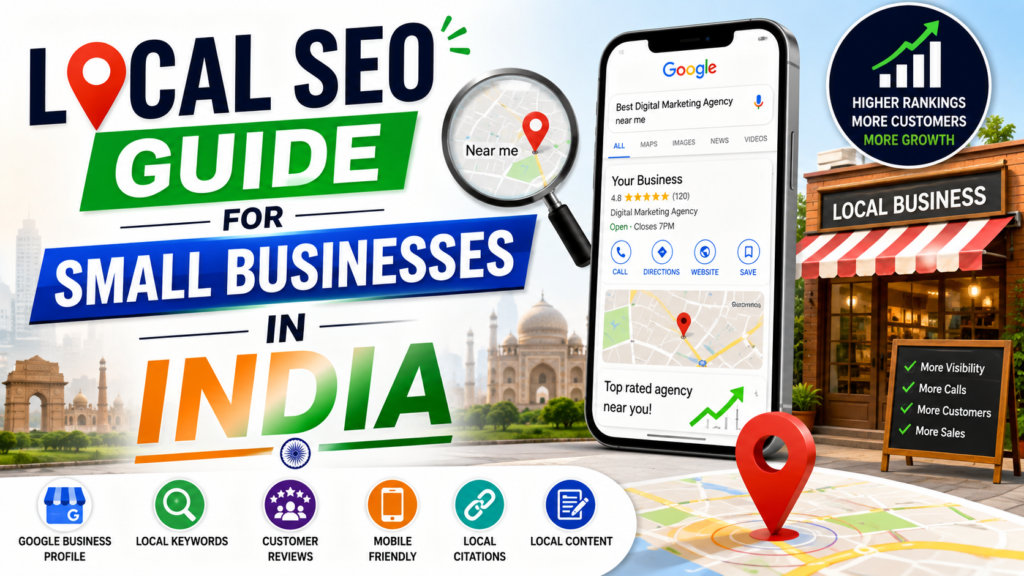
Local SEO Guide for Small Businesses in India

Local SEO is one of the most effective ways for small businesses in India to attract customers from their nearby area. Whether you run a restaurant, salon, digital marketing agency, clothing store, clinic, coaching centre, repair service, or any other local business, appearing when people search for your products or services nearby can bring valuable customers. Local SEO, or Local Search Engine Optimization, focuses on improving your online visibility for location-based searches such as “digital marketing agency near me,” “best salon in Mumbai,” “restaurants near me,” or “AC repair service in Ahmedabad.” Here is a practical guide to help small businesses in India improve their local SEO. 1. Create and Optimize Your Google Business Profile One of the most important steps in local SEO is creating a Google Business Profile for your business. Your profile can appear in Google Search and Google Maps when people search for businesses like yours. Make sure your business name, address, phone number, website, business category, opening hours, and services are accurate. Use your primary business category carefully because it helps Google understand what your business does. You should also upload high-quality photos of your storefront, products, services, team, and workplace. Regularly updating your profile can help keep your business information useful and current. 2. Use Local Keywords Keyword research is an important part of local SEO. Instead of targeting only broad keywords such as “digital marketing services,” consider location-specific keywords such as: Think about how your potential customers search for your services. You can also target “near me” searches, although you don’t need to repeatedly add the phrase “near me” to your website. Google can use location signals to understand whether your business is relevant to a nearby search. 3. Optimize Your Website for Local Search Your website should clearly communicate what you offer and where you offer it. Include your business name, location, contact details, services, and relevant local information. For example, a digital marketing agency serving Ahmedabad could have a page titled: “Digital Marketing Services in Ahmedabad” The content should naturally explain the company’s services, experience, service area, and customer benefits. Avoid unnecessarily repeating keywords. Write for people first and search engines second. 4. Create Location-Specific Pages If your business serves multiple cities, location pages can help you target different markets. For example, a business serving Gujarat might create useful pages for: Each page should contain unique and useful information rather than simply changing the city name on the same page. Include information about the services available in that location, local customer needs, relevant examples, FAQs, and contact information. 5. Get More Customer Reviews Customer reviews are extremely valuable for local businesses. Encourage satisfied customers to leave genuine reviews on your Google Business Profile. Reviews can help potential customers understand the quality of your products or services before contacting you. Don’t buy fake reviews or create reviews yourself. Instead, make it easy for real customers to share their experiences. You can politely ask customers after completing a successful project or purchase. Respond to both positive and negative reviews professionally. A thoughtful response shows that your business values customer feedback. 6. Keep Your Business Information Consistent Make sure your business information is consistent across your website, Google Business Profile, social media profiles, directories, and other online platforms. Pay particular attention to your: Name + Address + Phone number (NAP) For example, don’t use different phone numbers or significantly different versions of your business name across important profiles without a good reason. Consistency makes it easier for customers and search engines to understand your business. 7. Build Local Citations A local citation is a mention of your business information on another website or directory. Depending on your industry and location, you can consider relevant Indian business directories, industry-specific platforms, local associations, chambers of commerce, and other trustworthy websites. The goal isn’t to list your business everywhere. Quality and relevance are more important than quantity. Avoid low-quality directories that exist primarily to generate links. 8. Create Local Content Blogging can help small businesses attract people searching for information related to their products, services, and location. For example, a digital marketing business could publish: Local content can demonstrate your expertise while targeting searches relevant to your potential customers. 9. Use Social Media to Build Local Visibility Social media isn’t a replacement for SEO, but it can support your overall online presence. Create profiles on platforms where your target audience spends time. Share useful content, customer success stories, behind-the-scenes posts, offers, educational videos, and local information. Use location tags and relevant hashtags naturally when appropriate. For example, a local business in Jaipur could use content related to Jaipur business tips, local events, customer experiences, and its specific industry. 10. Make Your Website Mobile-Friendly A large number of people search for local businesses using smartphones. Your website should therefore work well on mobile devices. Check that: A potential customer shouldn’t have to struggle to find your phone number or address. 11. Add Local Business Information and Structured Data Businesses can use LocalBusiness structured data on their websites to provide search engines with information about their organization. Depending on your business, this can include details such as your name, address, telephone number, opening hours, and other relevant information. Structured data doesn’t guarantee higher rankings, but it can help search engines understand your business information. 12. Track Your Local SEO Performance SEO takes time, so track your results instead of guessing. Monitor things such as: The most important metric isn’t simply ranking #1. The real goal is attracting relevant local customers and converting them into leads or sales. Conclusion Local SEO can be a powerful growth strategy for small businesses in India. You don’t need a huge marketing budget to get started. Begin with the basics: optimize your Google Business Profile, use relevant local keywords, improve your website, collect genuine reviews, maintain consistent business information, create useful local content, and track your results. The key is consistency. Local SEO is not a one-time activity. Regularly update your business information,

BLOG

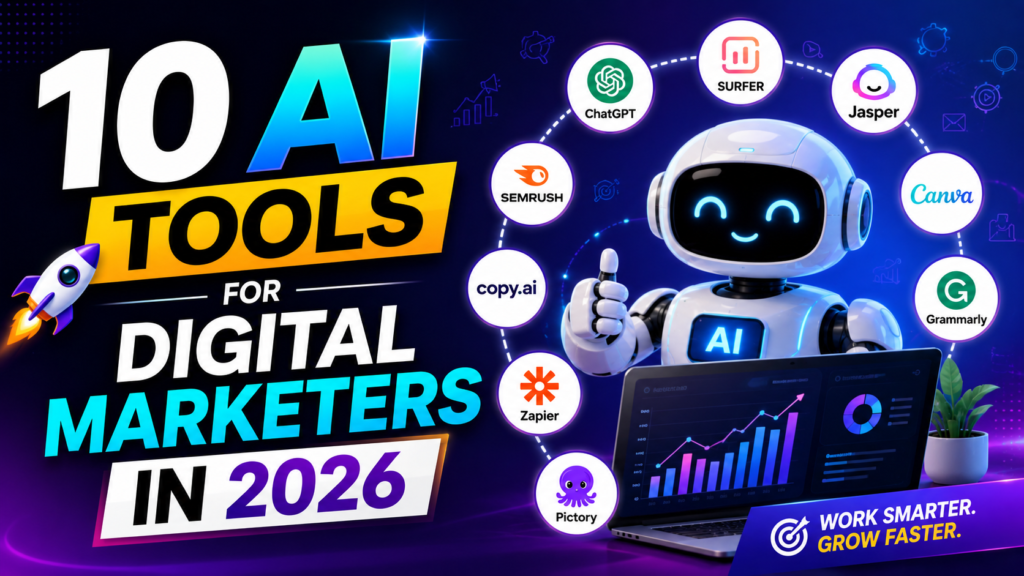
10 AI Tools for Digital Marketers in 2026

Artificial intelligence has become an important part of modern digital marketing. From creating content and designing graphics to improving SEO, analyzing data, managing campaigns, and automating repetitive tasks, AI tools can help marketers work faster and more efficiently. In 2026, AI marketing tools are no longer limited to simple content generation. Many platforms now combine AI with SEO, customer relationship management, advertising, analytics, design, and automation. Canva, for example, describes AI marketing tools as software that uses technologies such as machine learning, natural language processing, and data analytics to support and automate marketing activities. Here are 10 useful AI tools that digital marketers should know about in 2026. 1. ChatGPT – Content & Marketing Assistant ChatGPT can be used for a wide range of digital marketing tasks. Marketers can use it to brainstorm content ideas, create social media captions, develop blog outlines, write email drafts, generate ad-copy variations, create video scripts, and research marketing concepts. It can also help marketers analyze information and develop content strategies. The biggest advantage is flexibility. Instead of using a separate tool for every small task, marketers can use ChatGPT as a general-purpose assistant. However, marketers should always review AI-generated content and add their own expertise, examples, and brand voice. 2. Canva AI – Design & Visual Content Visual content is essential for social media marketing, blogs, advertisements, presentations, and websites. Canva’s AI-powered features can help marketers create designs, generate content, edit images, and develop marketing materials more efficiently. Canva specifically positions its AI tools as solutions for marketing workflows and creative production. Even marketers without professional graphic-design skills can use Canva to create social media posts, thumbnails, banners, presentations, and promotional materials. For digital marketers, this can significantly reduce the time required to produce visual content. 3. Jasper – AI Marketing Copywriting Jasper is designed specifically around business and marketing content. It can assist with advertisements, website copy, email campaigns, social media content, product descriptions, and other marketing materials. One of its useful applications is maintaining consistency in marketing communication. Marketers can provide information about their brand, audience, tone, and objectives and use the platform to develop content around those requirements. Jasper is particularly useful for businesses that produce large amounts of marketing copy. 4. Semrush – AI-Powered SEO & Marketing Research SEO remains an important part of digital marketing, and AI is increasingly being incorporated into SEO platforms. Semrush can help marketers with keyword research, competitor analysis, content strategy, website audits, and search visibility. Its newer AI visibility capabilities also focus on how brands appear in AI-generated search experiences. This is increasingly important because customers are discovering information through AI-powered search as well as traditional search engines. Marketers can use tools such as Semrush to identify opportunities and understand where their brand stands against competitors. 5. Surfer – AI Content & SEO Optimization Surfer focuses heavily on content optimization and SEO. It can help marketers analyze search results and improve website content based on factors associated with search visibility. In 2026, Surfer is also expanding its focus toward AI-search visibility alongside traditional SEO. For bloggers and content marketers, this can be useful when creating articles that need to be both helpful to readers and optimized for search. The important thing is not to write only for algorithms. Content should remain useful, original, readable, and relevant to the audience. 6. HubSpot AI – CRM & Marketing Automation HubSpot combines marketing, sales, customer relationship management, and automation. Its AI-powered marketing tools can help businesses identify high-intent leads, personalize customer experiences, create campaigns, manage advertising activities, and improve visibility in AI search. This makes HubSpot particularly useful for businesses that want to connect marketing activities with customer data. For example, instead of manually following up with every lead, businesses can create automated workflows that send relevant messages based on customer actions. 7. Perplexity – Research & Information Discovery Research is an important part of digital marketing. Before creating content, marketers often need to understand trends, competitors, customer questions, and industry developments. Perplexity can help marketers research topics and discover information through an AI-powered search experience. It can be useful for generating research starting points, finding sources, comparing information, and discovering questions that audiences may be asking. Marketers should still verify important information using reliable primary sources before publishing it. 8. Grammarly – AI Writing Assistant Good marketing communication needs to be clear and professional. Grammarly’s AI-powered writing features can help marketers improve grammar, clarity, tone, and overall writing quality. It can be useful when writing emails, website content, social media posts, proposals, advertisements, and other business communications. For marketers working with clients, polished writing can make a significant difference in how professional a brand appears. 9. Zapier AI – Workflow Automation Digital marketers often perform repetitive tasks every day. For example, a marketer might receive a lead through a website form, add that lead to a CRM, send an email notification, update a spreadsheet, and create a follow-up task. Automation platforms such as Zapier can connect different applications and automate these workflows. AI can make these workflows more flexible by helping users create and manage automated processes. This allows marketers to spend more time on strategy and creativity instead of repetitive administrative work. 10. Meta Advantage+ – AI-Powered Advertising Paid advertising is another area where AI is becoming increasingly important. Meta’s Advantage+ tools use automation and machine learning to help advertisers optimize campaigns across Meta’s advertising ecosystem. Instead of manually controlling every aspect of a campaign, marketers can provide campaign objectives, creative assets, audiences, and budgets while automated systems help optimize delivery. This can be particularly useful for businesses running Facebook and Instagram advertising campaigns. Why Should Digital Marketers Learn AI Tools? The goal of AI should not be to replace digital marketers. Instead, it should help marketers work smarter and faster. AI can handle many repetitive or time-consuming activities, allowing marketers to spend more time understanding customers, developing strategies, creating original ideas, and making business decisions. However, using AI effectively requires more than simply

BLOG

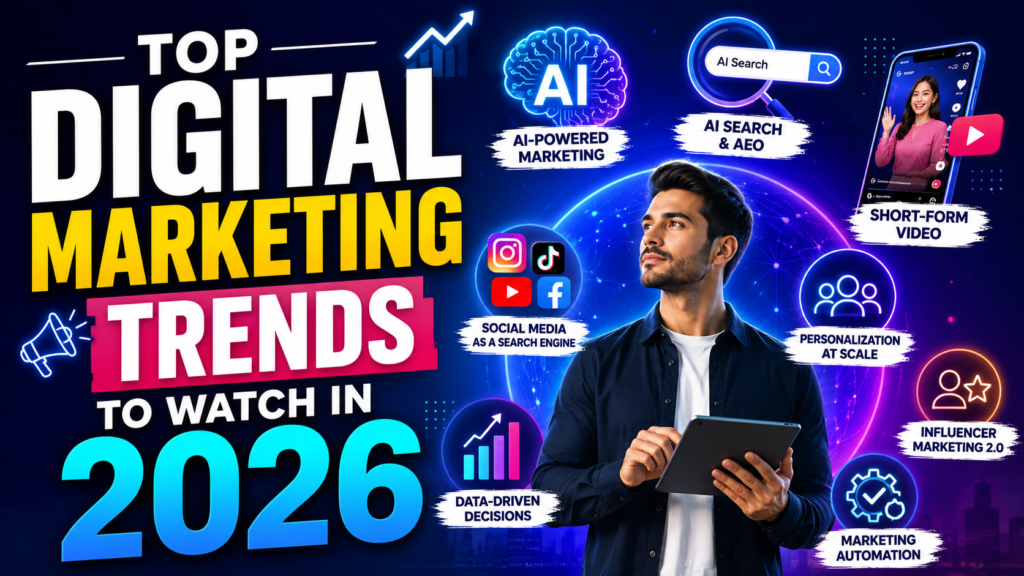
Top Digital Marketing Trends to Watch in 2026

Digital marketing is changing faster than ever. New technologies, changing customer behavior, artificial intelligence, and evolving social media platforms are transforming the way businesses attract, engage, and convert customers. In 2026, businesses can no longer depend only on traditional SEO, social media posts, or paid advertising. They need to understand where customers are searching, how they consume content, and how technology is influencing their buying decisions. Google’s 2026 marketing outlook highlights AI-driven consumer behavior, conversational search, visual content, community participation, and changing consumer expectations as major forces shaping marketing. Here are some of the top digital marketing trends to watch in 2026. 1. Artificial Intelligence Becomes a Marketing Essential AI is one of the biggest trends in digital marketing in 2026. Businesses are using AI to create content, analyze customer behavior, automate repetitive tasks, generate advertising ideas, personalize campaigns, and improve customer service. AI can help marketers save time and produce content more efficiently. For example, marketers can use AI to brainstorm blog topics, create social media captions, write email drafts, analyze campaign data, and develop video concepts. However, successful marketers will not simply publish AI-generated content. Human creativity, experience, originality, and brand personality remain important. The best strategy is to use AI for efficiency and humans for creativity and strategy. 2. AI Search and AEO Are Changing SEO Search is becoming more conversational. Instead of typing short keywords, users are increasingly asking detailed questions and expecting direct answers. Google’s AI Mode has surpassed one billion monthly users globally, and Google reports that AI Mode queries have more than doubled each quarter since its launch. This means businesses need to think beyond traditional SEO. Answer Engine Optimization (AEO) and Generative Engine Optimization (GEO) are becoming important concepts. The goal is to create authoritative, useful, well-structured content that can be understood and referenced by AI-powered search experiences. Businesses should focus on: Google is also introducing features that help users discover original content and trusted sources within AI Search. 3. Short-Form Video Continues to Grow Short-form video remains one of the most powerful ways to attract attention online. Instagram Reels, YouTube Shorts, and other short-video formats allow businesses to communicate their message quickly and creatively. In 2026, simply creating videos is not enough. Businesses need to create content that provides value, entertainment, education, or a strong point of view. For example, a digital marketing professional could create short videos such as: Short videos can also be repurposed across multiple platforms, helping businesses get more value from one piece of content. 4. Social Media Is Becoming a Search Engine People are increasingly using social platforms to discover businesses, products, services, creators, and information. This means marketers need to optimize social media content for discoverability, not just engagement. Using relevant keywords in captions, video titles, profiles, and on-screen text can help users find content when they search within social platforms. For example, instead of using a caption such as “Today’s marketing tip 🚀,” a marketer could use: “5 Digital Marketing Tips for Small Businesses in 2026.” The second option clearly communicates the topic and can potentially reach people searching for digital marketing advice. 5. Personalization Will Become More Important Customers don’t want to feel like they are receiving the same generic message as everyone else. AI and customer data are making personalization easier. Businesses can analyze customer behavior and provide more relevant content, product recommendations, emails, and advertisements. For example, an online store can recommend products based on previous browsing behavior, while an email campaign can provide different messages to new customers and existing customers. The future of digital marketing will increasingly focus on delivering the right message to the right person at the right time. 6. Authenticity and Human Content Will Stand Out As AI-generated content becomes easier to produce, the internet will contain more generic content. This creates an opportunity for businesses that provide something AI cannot easily replicate: real experience. Original case studies, customer stories, personal opinions, behind-the-scenes content, expert advice, demonstrations, and real-world examples can help brands build trust. In 2026, businesses should not only ask, “Can AI create this content?” They should also ask: “What unique experience or knowledge can we add?” That human element can make content more memorable and credible. 7. Influencer Marketing Is Becoming More Strategic Influencer marketing is evolving from celebrity endorsements toward creators, experts, and niche communities. A business doesn’t always need a creator with millions of followers. A smaller creator with a highly relevant audience may generate better engagement and trust. For example, a local fitness business might benefit more from working with a fitness creator in its city than from hiring a massive international influencer. The focus is shifting from follower count to relevance, trust, engagement, and conversions. 8. First-Party Data Will Become More Valuable Privacy changes and increasing dependence on third-party platforms are encouraging businesses to build audiences they can communicate with directly. Email lists, CRM databases, customer accounts, communities, and permission-based messaging channels can become valuable marketing assets. Instead of depending entirely on Instagram, Google, or another platform to reach customers, businesses should build their own audience. This creates a more sustainable marketing strategy and gives businesses greater control over customer relationships. 9. Marketing Automation Will Save More Time Automation is becoming increasingly important for businesses of all sizes. Marketers can automate tasks such as email sequences, lead follow-ups, appointment reminders, customer segmentation, reporting, and social media workflows. When combined with AI, automation can help businesses respond faster while reducing repetitive manual work. However, automation should improve the customer experience rather than make communication feel robotic. 10. Measuring ROI Will Matter More Than Vanity Metrics Likes, views, and followers can be useful indicators, but they don’t always represent business success. In 2026, businesses should focus more on metrics such as: A campaign with 10,000 views and zero customers may be less valuable than a campaign with 2,000 views that generates 50 qualified leads. The future of digital marketing will therefore be increasingly data-driven and results-focused. Conclusion Digital marketing in

BLOG

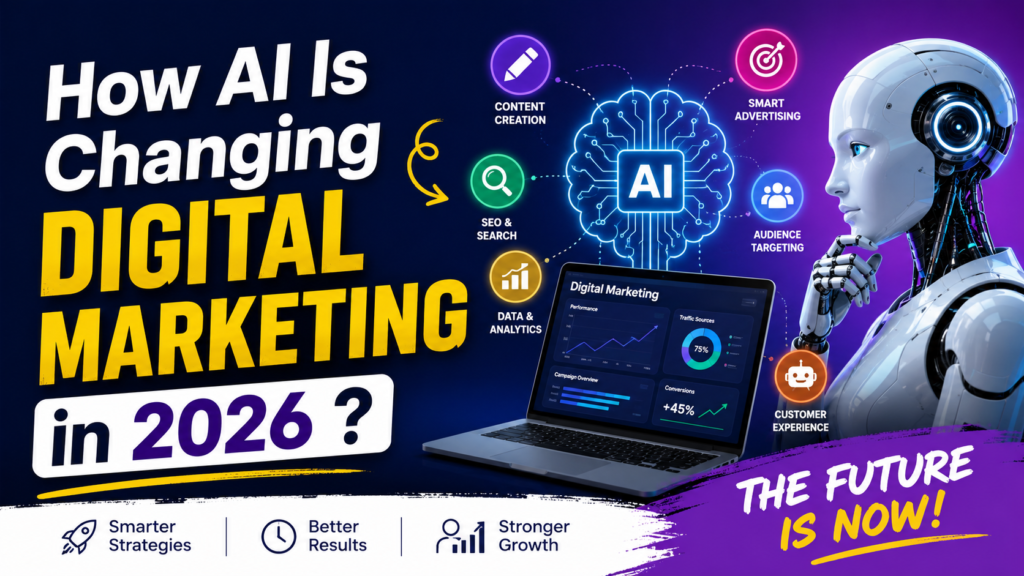
How AI Is Changing Digital Marketing in 2026 ?

Artificial Intelligence (AI) is no longer just a futuristic technology. In 2026, it has become an important part of everyday digital marketing. From creating content and analyzing customers to improving SEO, managing advertising campaigns, and personalizing customer experiences, AI is helping businesses market faster and more efficiently. At the same time, AI is changing how people discover information online. Google has expanded AI-powered Search through AI Overviews and AI Mode, while AI-driven search is encouraging users to ask longer, more conversational questions. Google reported in May 2026 that AI Mode had surpassed one billion monthly active users globally and that AI Mode queries had more than doubled each quarter since launch. For marketers, this means that digital marketing in 2026 is not simply about producing more content. It is about using AI intelligently while maintaining creativity, trust, and a strong understanding of customers. 1. AI Is Transforming Content Creation One of the biggest changes AI has brought to digital marketing is faster content creation. Marketers can use AI tools to generate blog ideas, social media captions, email drafts, video scripts, ad copy, and content outlines within minutes. For example, instead of spending hours brainstorming 20 Instagram post ideas, a marketer can use AI to generate ideas based on a specific audience, industry, or campaign goal. However, AI-generated content should not simply be published without review. As more businesses use similar AI tools, generic content can easily become repetitive. Successful brands will need to add human experience, opinions, examples, storytelling, and original insights to make their content stand out. In 2026, AI is best viewed as a content assistant rather than a complete replacement for the marketer. 2. SEO Is Moving Toward AI Search Traditional SEO focused heavily on ranking webpages for specific keywords. But search is becoming more conversational and AI-powered. Google’s AI Overviews and AI Mode can provide users with AI-generated answers while also directing them toward relevant websites and original content. Google has also introduced features designed to help users discover original sources and firsthand perspectives within AI Search. This creates a new opportunity for marketers. Instead of focusing only on ranking for one keyword, businesses should create useful, authoritative, well-structured content that clearly answers customer questions. For example, rather than writing an article simply targeting “digital marketing agency,” a business could create detailed content answering questions such as: This approach can help businesses become useful sources of information across traditional and AI-powered search. 3. AI Is Making Advertising Smarter Paid advertising is another area being transformed by AI. Platforms such as Google and Meta increasingly use machine learning and automation to help advertisers identify audiences, optimize campaigns, test creative variations, and allocate budgets. Instead of manually adjusting every campaign element, marketers can increasingly provide goals, budgets, audience signals, and creative assets while AI handles much of the optimization. This can save time and improve efficiency, particularly for small businesses that may not have large advertising teams. However, marketers still need to understand targeting, positioning, creative strategy, conversion tracking, and customer behavior. AI can optimize a campaign, but it cannot automatically determine the best business strategy in every situation. 4. Personalization Is Becoming More Powerful Customers expect brands to provide relevant experiences. AI makes personalization possible at a much larger scale. Businesses can use AI to analyze customer behavior and identify patterns such as what customers search for, what products they view, what emails they open, and what content they engage with. This information can then be used to create more relevant marketing messages. For example, an online store could show different product recommendations to different customers based on their interests and previous interactions. The result is a more personalized customer journey, potentially improving engagement and conversions. 5. AI Is Improving Customer Service AI-powered chatbots and virtual assistants are becoming increasingly common in digital marketing. A business can use an AI chatbot to answer frequently asked questions, explain services, collect leads, schedule appointments, or guide customers toward relevant products. This means customers can receive assistance outside normal business hours. However, businesses should provide an easy way for customers to reach a human when a question is complex or sensitive. Good customer experience requires a balance between automation and human interaction. 6. Data and Analytics Are Becoming More Valuable Digital marketing produces enormous amounts of data. AI can analyze this information much faster than humans can manually. AI can help marketers identify trends, understand customer behavior, predict potential outcomes, and discover which campaigns are performing well. For example, instead of simply looking at website traffic, marketers can analyze which visitors are most likely to become customers and which marketing channels are generating valuable leads. This allows businesses to make more data-driven marketing decisions rather than relying only on assumptions. 7. Human Creativity Still Matters Despite the rapid growth of AI, creativity and human judgment remain extremely important. AI can generate hundreds of headlines, captions, images, and ideas, but it does not automatically understand a brand’s personality, culture, audience emotions, or unique experience. In fact, as AI-generated content becomes more common, authenticity can become a competitive advantage. Brands that combine AI efficiency with human creativity, expertise, and original experiences can create content that feels more trustworthy and memorable. Conclusion AI is changing digital marketing in 2026 by making marketing faster, smarter, more personalized, and increasingly automated. It is transforming content creation, SEO, advertising, analytics, customer service, and audience targeting. But the future of marketing is not simply AI versus humans. The strongest approach is likely to be AI + human expertise. Marketers who learn how to use AI tools while continuing to develop skills in strategy, creativity, SEO, storytelling, branding, and customer psychology will be better positioned to succeed. The biggest lesson for businesses is simple: don’t use AI just to create more marketing—use it to create better marketing. In 2026, the brands that combine technology with authenticity, useful content, and genuine customer value will have the strongest opportunity to stand out.

Scroll to Top
Call Now Button